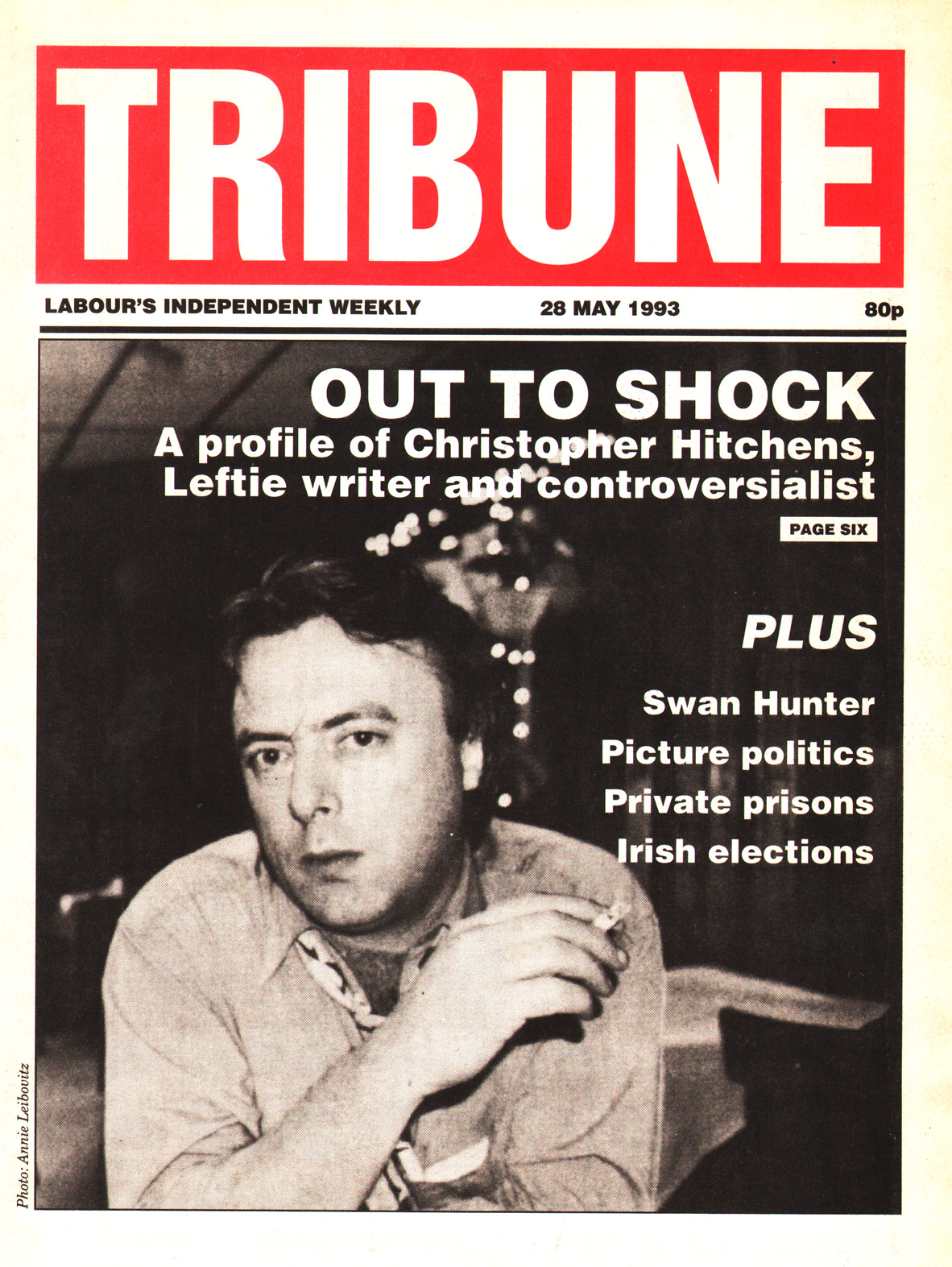
HAVING A GO: INTERVIEW WITH CHRISTOPHER HITCHENS

Tribune, 28 May 1993

The journalist and controversialist is back from the US to launch a new book of essays. He talks to Paul Anderson

“We play a game on the left in America,” says Christopher Hitchens. “Which election do you wish that the Republicans rather than the Democrats had actually won?

“Some very daring souls say that if Thomas Dewey had beaten Harry Tru¬man in 1948 there would have been no cold war,” he says. “People can never dare to take it back as far as Franklin Roosevelt. And some of them don’t agree with me that Barry Goldwater should have beaten Lyndon Johnson in 1964 – because then there would have been no Vietnam war.”

Hitchens, in London for the launch of his latest collection of essays, For the Sake of Argument (Verso, £18.95), delights in upsetting received wisdoms, particularly those of the left.

Indeed, he does it for a living. Since leaving Britain for the United States 15 years ago, he has written a column for The Nation, the American weekly that plays much the same role as the New Statesman here, in which he has made a speciality of stirring up as much controversy as he can in pursuit of hypocrisy and cant.

He has done much the same in many other Ameri¬can periodicals and, particularly of late, on television and radio talk shows, becoming something of a minor celebrity.

America, it seems, loves to hate Hitchens’s posh Brit drawl, his alien far-left politics and his ability to shock. Here, we get the articles between hard covers, and late. Some of the stuff in For the Sake of Argument dates back to 1987, although most, including the best of the columns from The Nation, are from 1990-92. Still, late is better than never.

The book includes pieces on an extraordinary range of themes – from P. G. Wodehouse through the delights of “Booze and fags” (written, he claims, “while cold sober”) to the fatwa against Salman Rushdie – and it is all worth reading. But the best bits, undoubtedly, are his commentaries on American politics, especially the no-holds-barred assault on Bill Clinton, which has been almost uninterrupted since the Arkansas governor started running for the Democratic presidential nomination.

“So what is all this garbage about ‘the new paradigm’ of Clinton’s forthright Southern petty-bourgeois thrusting innovative fearless blah blah blah?” he yelled at readers of The Nation in March last year after Clinton had authorised the execu¬tion of a prisoner on death row. “In a test of principle, where even the polls have shown that people do not demand the death penalty, he opted to maintain the foulest traditions and for the meanest purposes. As the pundits keep saying, he is a man to watch.”

It is clear that Hitchens is already well on the way to deciding that last year’s election was one of those that the Democrats should have lost. Clinton is proving precisely the disaster that he thought he would be.

“In the campaign, his only consistent point was to say that he would cut the tax burden insofar as it fell on the ‘middle classes’, whom he refused to define,” he says. “He wanted everyone who heard that message to think it meant them. Now he’s increasing taxes, mainly on the middle-income population, and everyone in the administration is pretending that this isn’t a breach of promise.

“You’re supposed to get points for lying in that way, and you do get them from the opinion poll racket and from the people who write columns in the bourgeois press. But actually it isn’t all that smart because people find you out quite quickly.”

Clinton, he goes on, was an establishment candidate, bankrolled by Wall Street and special-interest lobbies. “The reason substantial sections of the establishment swung to him is that they’re afraid of the underclass. It was the Los Angeles riots that got Clinton elected. His test will be whether he can bring in these people who are very nearly excluded from society.”

So far, the signs are ominous. The reform of the health service that Clinton promised during the campaign has already foundered, as has his at¬tempt to give a boost to the economy.

On foreign policy, “in many areas he’s worse than George Bush”, says Hitchens, quoting the new president’s policies on the Middle East (where Clinton has been much more sympathetic to the Israel lobby than his predecessor), Cuba (where he “campaigned against Bush from the right”) and nuclear testing.

“Whatever you think about Bosnia, it is only possible to say that Clinton has been contemptible. He played with all sorts of solutions, raised expectations and, when anything showed signs of giving the least political difficulty, he dropped it. By any standards, a really low-grade performance.”

The only thing that Clinton is good at, according to Hitchens, is appealing to the myriad of special-interest lobbies that make up so much of what thinks of itself as the American left: “He has manipulated images so that people in the gay movement, the feminist movement, the civil rights movement and the Hispanic lobby feel that privately he’s on their side.”

Hitchens is scathing about this pandering to what he calls “identity politics” – the idea that there is something radical about identifying oneself as a member of a group ‘“oppressed” by dint of sharing such traits as skin colour, gender or sexual preference.

His opposition is not based on a reactionary yearning for a society run by white male heterosexuals: rather, his point is that the growing importance of racial and sexual identities in politics is a symptom of social fragmentation, with no necessarily radical implications. “The left has falsely convinced itself that there are all of these individual emancipations going on, and I think it’s going to be disappointed. What’s missing in all this is any conception of citizenship or comradeship or the common good. And that’s too precious to give up to any special claim.”

Hitchens’s initial journalistic reputation was founded on his coverage of British politics in the seventies, particularly for the New Statesman. He left for the US and The Nation because “the Statesman was going down the karsy very suddenly and very depressingly and there was nowhere else that I wanted to go or would have had me. Everything else looked pretty lousy too: the experience of the Callaghan years, seeing Thatcherism coming. I thought: ‘If I don’t get out now, I never will.’“ Even the left of the late seventies suffered from “extreme crumminess”, and the Labour left was worst of all. “Internal fights on the National Executive Committee don’t make very interesting copy even if you’re interested in it,” he says.

For all this, he retains a keen partisan interest in Britain. He is, of course, no admirer of the contempo¬rary Labour Party. One of the best pieces in For the Sake of Argument is “Neil Kinnock: Defeat Without Honour”, written for The Nation after last year’s British general election, an excoriating assault on Labour’s failed strategy in the late eighties; “Tell us what you want, it wheedled the voters, and we will agree to stand for it. Here are our principles, and if you don’t like them, we’ll change them.”

Hitchens has not changed his mind in the past year. Unsurprisingly, he is particularly hard on the Clintonmania that hit Labour’s upper echelons six months ago. “Clinton’s victory was something to cling to after the humiliation of Kinnock: here’s the new paradigm – apolitical, technocratic, lowest common denominator – and it works!

“Labour has learned absolutely nothing from the defeat of Kinnock. All its leaders think is: ‘Well, we must try harder next time.’“ He remembers John Smith from the seventies as “a talkable-to guy”. But “throughout the whole of the Wilson-Callaghan humiliation I don’t think he gave the whips any trouble at all. He’s a conformist, a complete conformist.

“People always say: ‘Well, what about the alternative?’ That, of course, turns any dolt into a master political strategist, as we saw with the Kinnock team. ‘Consider the alternative’ would be my slogan.”

ACT GLOBAL: INTERVIEW WITH MICHAEL MEACHER

Tribune, 21 May 1993


Labour’s aid and development spokesman talks to Paul Anderson about Bosnia and the role of intervention

“Thousands upon thousands of innocent civilians to be murdered and mutilated and tortured,” says Michael Meacher. “Can the European Community really do nothing to stop aggression against a European country whose independence and sovereignty it recognised?” Needless to say, Meacher is talking about the war in Bosnia, a subject on which, despite being a member of the Shadow Cabinet, he has often come close to contradicting the cautious official Labour line expressed by Jack Cunningham, the Shadow Foreign Secretary.

Meacher, the MP for Oldham and Labour’s spokesman on aid and development, does not hold with the view that what is happening in Bosnia is simply a three-sided civil war in which no single side should be seen as the worst offender. Although “well aware that the Serbs have a case” and that “atrocities have occurred on all sides”, he clearly identifies the Serbs as the aggressors in the war.

Disgusted by the fact that United Nations humanitarian relief convoys have had to ask the Serbs’ permission in order to reach the besieged Muslims, he asks: “Can we allow UN authority to be made dependent on the will of the aggressor? If we live in a civilised world, we cannot allow these things to go on.” In line with this, he is much more hawkish than most of his Shadow Cabinet colleagues about military intervention. Rather than simply backing air strikes on the Bosnian Serbs’ supply lines if they continue to reject the Vance-Owen plan for cantonising Bosnia, Meacher wants deployment of ground troops to defend the Muslims against attack.

“It is hopeless to deliver humanitarian aid if we abandon people to be wiped out,” he says. “Safe havens must be implemented. That means giving real protection for the besieged Muslim enclaves and a new mandate for the UN troops there. There has to be UN defensive military protection. There is a difference between this and an offensive war, pushing the Serbs back from their ill-gotten gains.

No one is asking for that.” Meacher does not believe that intervention on the lines he suggests would take a massive army.

“A well-trained professional force, with modern technology, command of the air, helicopter gunships and armour could have a really big impact quickly.” While Cunningham has consistently portrayed the Vance-Owen plan as a viable basis for peace in Bosnia, Meacher describes it as “deeply flawed”. “It rewards aggression and ethnic cleansing. It depends on the creation of enclaves, undermines the unitary state and completely ignores the question of the refugees,” he says. “There are 2,500,000 refugees, most of them in the former Yugoslavia but some 500,000-750,000 outside. Are they to become the Palestinians of Europe? If so, even if we get a ceasefire, we won’t get peace but a running sore of violence in central Europe for decades to come.


“The only merit of Vance-Owen is that, if the Serbs sign up to it, it just might get a ceasefire. It is not remotely tenable as a long-term political solution: the difficulty is the map, which none of the three sides will accept, except perhaps the Croats.” The real issue, he goes on, is finding an alternative to Vance-Owen that could form the basis for a long-term political settlement. “I would still like to believe that there is a possibility of retaining a unitary state with a high degree of local autonomy,” he says. “The only other option is partition. We can’t rule that out if that’s the only way of keeping the peace. It’s certainly better than a whole series of wars.”

+++

Bosnia is not the only place where Meacher would like to see outside intervention in what traditionalists consider to be the “internal affairs” of a sovereign state.


Indeed, he considers that, with the tensions of the cold war at an end and hot wars raging in many parts of the world, the time has come for the international community to limit countries’ rights to carry on as they like within their own borders.

“There are certain extreme cases in which an individual country’s sovereignty should be over-ridden,” he says. “The first is genocide. The second is total breakdown of law and order and all government institutions, as we saw in Somalia. The third is when free and fair elections are held and deliberately over-ridden — Angola, Burma, Haiti, for example.”

Military intervention, he says, should always be the last resort: there is a whole series of other pressures, from withdrawing diplomatic relations, through withholding aid, to full-blown sanctions, that should be applied and found to fail before military action is considered. Equally importantly, all these pressures should be applied by the UN rather than by a single member-state or group of memberstates.

“This is nothing to do with neo-colonialism,” Meacher emphasises. “We’re talking about protecting innocent people from violence.” This notion of redefining the role of the international community in countries’ internal affairs is just one part of a “completely different foreign affairs and development agenda” that he would like to see adopted. With the cold war over, he argues, the great divide in world politics is between the rich developed North and the poor, underdeveloped, indebted South.

“I was staggered when I came to this job to find that current indebtedness of the Southern world is £850,000 million. The effect is utterly crippling. We are driving countries into impoverishment for decades to come.” Debt repayments by the poor countries to the rich ones are now almost double the total of aid from rich to poor countries.

“Debt relief is not only necessary but also in our own self-interest. It could create demand for our goods and services that we are not going to get from anywhere else. We must be crazy not to seize the opportunity to help ourselves and those in the South.” He suggests that 60 per cent of Third World debt be written off and easier terms agreed for the rest.

Meanwhile, he goes on, the rich countries must “reject the temptations of protectionism and remove barriers to the import of processed goods from the South”, in order ‘toles:Ince the Iatter’s reliance on primary products, prices of which have slumped in recent years. Structural adjustment programmes, the privatisation-and-deregulation packages forced on developing countries by the World Bank and the International Monetary Fund, “have repeatedly failed and should be denounced”, says Meacher. “We’ve got to come up with an alternative.”

On aid, he makes familiar Labour points about the Tory government’s halving of its commitment since 1979, arguing that the position has been made even worse by the diversion of large parts of the aid budget from the poor South to the countries of the former Soviet bloc. He also insists that “part of an aid and development policy must be protection of fundamental human rights”, with aid channeled only through non-governmental organisations in countries that are not up to scratch. Finally, he says that aid and development cannot be dissociated from the requirements of law and order.

“In Mogadishu last year I was shown a warehouse piled to the ceiling with sacks of maize. A couple of miles away, according to Save the Children, a couple of thousand people, mainly children, were dying each day. But the food could not be distributed because of the fighting.”

+++

Meacher’s enthusiasm is such that it is difficult to credit that he was given the post of aid and development spokesman last year as a way of shunting him to one side. Nevertheless, he clearly believes that his brief is not given enough priority by the contemporary Labour Party.


“Labour is not engaging with the electorate as effectively as it could be in evoking a crusade, a vision, a sense of purpose, in enthusing people,” he says. “There are people out there who need to be convinced that the Labour Party has got stuck in on the fundamentals. This issue could play a big part in it. The sufferings and viciousness of the civil wars across the world so totally over-ride the arcane mysteries of Maastricht that it is astonishing that the Foreign Office can be so wound up in something that is so navel-oriented.”

LET’S MOVE QUICKLY TO A FEDERAL EUROPE

Tribune leader, 21 May 1993

The yes vote in Tuesday’s Maastricht referendum in Denmark does not bring to an end the argument about European union. But it does radically change its terms.

Ratification of Maastricht throughout the European Community is now guaranteed. The question now is not whether European union takes place but what sort of European union is built on Maastricht’s foundations.

Of course, those foundations are shaky.

As Tribune has argued, there is plenty that is wrong in the treaty. Its provisions for political union are wholly inadequate: instead of massively increased powers to the European Parliament, it gives pride of place in the new Europe to intergovernmental bodies. In the wake of the exchange-rate chaos and Europe-wide recession brought on by German unification, just about everyone now accepts that the timetable and convergence criteria for economic and monetary union laid down by Maastricht are unrealistically tough.

Then there is the problem of Britain’s opt-out on the social chapter, which denies British workers the rights enjoyed by their colleagues elsewhere in the EC.
Nevertheless, the British left should be breathing a sigh of relief at the Danish vote. Had they voted no, not just Maastricht but the very possibility of European union would now be dead. We would now be looking forward to life on the periphery of Europe, as Germany, France and the Benelux countries went it alone with an economic and political union of their own.

That would have been a disaster for the prospects of developing the pan-European institutions capable of carrying out the Europe-wide strategies for growth that the slump-hit continent so desperately needs.

Of course, Maastricht does not create those institutions, let alone the political will for implementing a European recovery programme. Without the treaty, however, it would have been impossible to conceive of their construction.

The task now is for Labour to put Maastricht behind it and to develop a coherent European policy that focuses on what the party would like to see coming out of the next round of intergovernmental conferences on European union, scheduled for 1996.

If Labour is serious about the idea of alternative European economic strategies, it has to advocate a much bigger role and greater powers for EC executive bodies and if it does that, it must suggest ways of making these bodies democratically accountable.

The obvious solution is to embrace wholeheartedly the goal of a democratic federal Europe, in which the European Parliament has much the same function as a parliament in a decentralised federal nation state. Whether Labour has the confidence to bite the bullet is another matter entirely.

COUNCIL DEALS ARE A LOCAL MATTER

Tribune leader, 14 May 1993

  
The Tories suffered humiliating defeats last week in the Newbury by-election and the county council elections. But Labour has precious little to celebrate.
In Newbury, the Labour candidate, Steve Billcliffe, got 1,151 votes, less than 2 per cent of the vote, and lost his deposit. It was the lowest Labour share of the vote in any parliamentary election since 1918 and, con­trary to Labour claims (after the result) that the party had run a deliberately low-key campaign, it happened despite strenu­ous Labour efforts to improve on last year’s general election showing.
This cannot simply be dismissed with a casual shrug of the shoulders. Although it is true that, as Peter Mandelson said, the voters of Newbury were essentially voting against the Tories, it is also true that the way they did so was by placing their cross­es next to the name of the Liberal Demo­crat candidate.
Given the scale of Labour’s humiliation, it is not treachery to ask whether it is worth going to the expense of fighting by-elections in seats that Labour knows it can­not win. It is ludicrous to claim that by-elections are an opportunity to get the mes­sage out to the nation: in Newbury the me­dia treated Labour as an irrelevant side-show. And the claim that running a candi­date in every by-election is essential if Labour is to maintain its credibility as a national party is more than outweighed if results prove that Labour’s claims to be a truly national party are exaggerated.
Of course, there are few seats in the country where Labour starts from quite such a low base of support as in Newbury – and there is always the argument that fighting hopeless seats is good practice for candidates and for the party apparatus. But Labour would be foolish to press on with its present policy without some seri­ous thought about its effectiveness.
Newbury saw a level of anti-Tory tacti­cal voting unlike anything witnessed before in a by-election, and it was not an isolated phenomenon. Throughout the south, voters in the county council elec­tions backed the candidate most likely to keep the Tory out. The result was humilia­tion for the Conservatives as they lost council after council. The main beneficia­ries were the Liberal Democrats – and this has inevitably raised the question of whether Labour should relax its antipathy to Lib-Lab coalitions in local government. In Tribune‘s view, the answer is simple: the party should allow county Labour groups to make up their own minds without inter­ference from the centre.
The more important issue is the implica­tions of the results for national politics. If the Liberal Democrat surge proves to be a one-off, Labour’s refusal to counte­nance talk of pacts and coalition will be vindicated. If, however, it presages a Liber­al Democrat revival that does serious dam­age to Labour’s chances in those parts of the south where the party needs to win seats, Labour’s line will look dangerously complacent and short-sighted.
Labour can see off the threat from the Liberal Democrats but only if it develops policies and a style of politics that appeal to people who are now tempted to vote Lib­eral Democrat. The problem is that it is still by no means clear that the party has either the will or the imagination to do so.
Desai wrongly sacked to save Smith blushes
Last week, Meghnad Desai was fired from his position as a front-bench Labour economic spokesman in the House of Lords. In his Tribune column last week he had written that, if Labour aban­doned its policy of increasing income tax for high earners, he would “remove zero-rating for VAT on all items” and compen­sate for the regressive impact of such a move by increasing benefits to the poorest.
No one in Gordon Brown’s office had actually read the article, so Mr Brown was caught unawares last Thursday when Norman La­ment, giving the false impression that the article backed Tory policy on tax, quoted it at him in the House of Commons. Subsequently, John Major did the same to John Smith during Prime Minister’s Questions on the same day: Mr Smith was made to look a complete fool after claiming that the article had been written while Professor Desai was on the back benches. Hours lat­er, Professor Desai was relieved of his post. The sacking has been treated as some­thing of a joke by most of the media, but it is nothing of the kind. In his Tribune column, Professor Desai was expressing opinions that are in no sense at odds with Labour Party policy – and the reason they are not is simple. Put bluntly, there is no finalised Labour policy on taxation and benefits. At the insistence of none other
than Mr Smith, the party contracted all that out to the Commission on Social Justice, which is supposed to have complete freedom to examine the options on funding the welfare state.
Professor Desai, by suggesting an .option for taxation policy, was playing a wholly le­gitimate part in a necessary debate. That he was sacked for doing so gives the impression not just that Mr Smith is petty and vindictive but, more importantly, that the whole party leadership is deeply intellectually insecure and intolerant of discussion. So much for “open opposition”, the buzz-phrase in so many party documents in recent months.

BOSNIA: SETTLEMENT MUST BE ENFORCED

Tribune leader, 7 May 1993

The wave of optimism that swept Eu­rope after Radovan Karadzic, the Bosnian Serb leader, signed the Vance-Owen plan for a settlement in Bosnia could all too easily turn out to be premature.
The first real test of last weekend’s agreement is not so much whether or not the Bosnian Serb “parliament”, meeting as Tribune went to press, endorses Mr Karadzic’s move but whether or not the Serb armed forces in Bosnia stop fighting and then withdraw from their positions in accordance with the timetable in the Vance-Owen plan.
It is essential to recognise that, as things stand, the likelihood of this happening is remote indeed. Fighting is still going on and shows no sign of ending. More impor­tant, nothing that we know about the Serbs’ previous behaviour or their war aims suggests that they will easily give up the territories that they have seized in the past year.
The Serbs have occupied much land, “ethnically cleansed” the countryside and besieged the towns in pursuit of a Greater Serbia stretching from Vojvodina in the north to the Adriatic coast, including large parts of Croatia and Bosnia.
The Vance-Owen plan has many faults, the most important of which is that its goal of a Bosnia cantonised on ethnic lines, which has already encouraged the Serbs and Croats in their seizures of land, is dan­gerously close to partition. Nevertheless, by resisting partition, preserving the terri­torial integrity of an ethnically diverse Bosnia and refusing to recognise the mili­tary gains of the past year’s war, the plan is an obstacle to the Serbs’ dream – and as such is unacceptable to the Serb forces on the ground in Bosnia.
In the end, it is their attitude that counts, not what Mr Karadzic might say when his arm is being twisted by the Serbian gov­ernment, desperate to have the sanctions against it lifted or at least eased.
Put bluntly, this means that the interna­tional community is very soon likely to be faced with a choice between capitulating in the face of Serb intransigence and some­how making the Serbs stop fighting and withdraw.
In such circumstances, as Jack running, ham, the shadow Foreign Secretary, has said, it would be idiotic to send in United Nations forces in a “peace-keeping” role: there would be no peace to keep and they would simply be sitting targets. A very dif­ferent sort of military intervention would be needed to force the Serbs to comply with the Vance-Owen provisions (or indeed some other plan for a post-war settlement in Bosnia, such as a United Nations protec­torate, if Vance-Owen falls apart).
So what sort of military intervention would do the trick? Essentially, we are back to the arguments that were raging before the outbreak of optimism in the wake of the Athens conference.
As Tribune argued a fortnight ago, air strikes on Bosnian Serb supply lines, sug­gested as a last resort by the Labour front bench, would not be enough: the indica­tions are that the Bosnian Serb forces have plentiful arms and ammunition. Interven­tion by ground forces, backed by heli­copter-borne forces and with air support, would be essential if they were to be made to accept a ceasefire and retreat.
Contrary to the arguments of opponents of such a course of action, this would not take a massive army, nor would it be irre­sponsibly risky. The Bosnian Serb forces are less than formidable. Their soldiers, some 60,000 in number, are ill-disciplined, ill-equipped and inexperienced, their ar­tillery immobile and their 300 tanks mainly ancient Soviet T-55s. They have advanced as far as they have only because the Bosni­an government, with 90,000 troops under arms, has had no adequate means of stop­ping the tanks. (This, incidentally, gives the lie to claims that the wooded mountain­ous terrain makes intervention by ground troops too difficult: tanks cannot operate in wooded mountains.) It is hard to believe that, confronted by well-equipped, profes­sional intervention forces, the Bosnian Serb forces would have much stomach for a fight.
The upshot is that a relatively small NATO force of around 50,000 to 75,000 troops – the same size as the peace­keeping force envisaged in the Vance-Owen plan – could, if necessary, force the Serb forces to lay down their arms and with­draw. Once it had done this job, it could be turned into a peace-keeping force. Alterna­tively, a separate UN blue-helmet force could be introduced to oversee implemen­tation of the political settlement.
The hope that it will not come to this, that the Bosnian Serbs will meekly act as the rest of the world wants them to and that a UN peace-keeping force will be all that is required from the international community, must not be allowed to eclipse hard-headed realism. West European gov­ernments are looking for any excuse to re­vert to hand-wringing if anything goes wrong with implementation of Vance-Owen: it is up to the left to keep the pres­sure on them so that they prepare for the worst.
Policy forum offers little hope of creative thinking
The idea behind Labour’s National Policy Forum, which meets for the first time this weekend, is not a bad one. For sev­eral years now, the party’s annual confer­ence has been a wholly inadequate forum for policy-making: trade union block votes have guaranteed that just about anything dreamed up by the small group of politi­cians in the Shadow Cabinet and the Na­tional    Executive    Committee    has    gone through on the nod. Labour needs some sort of body in which a wider group of people, including ordinary individual members, can have a real influence on party policy.
Unfortunately, there is little hope that the National Policy Forum as currently consti­tuted will fulfil any such role. Because of Labour’s financial crisis, it has – been slimmed down to just 100 members and will meet only annually instead of quarterly.
This weekend’s meeting will have only four hours of open debate – which works out at two-and-a-half minutes per member. That would be a great formula for a radio quiz game, but it is hardly the way for a serious political party to behave.
It will be a miracle if the forum is the source of creative thinking and constructive debate that the party’s spin-doctors claim it will be.

KEYNESIANISM IN ONE COUNTRY IS NOT ON

Tribune leader, 30 April 1993

The government has been wrong so of­ten before about the imminence of Britain’s recovery from recession that it has been simple for Labour to be scepti­cal about this week’s gross domestic product statistics for the first quarter of 1993, particularly as most credible inde­pendent analysts agree that the recovery is, at best, tentative.
Unemployment has yet to reach its peak and consumer confidence remains low. The manufacturing base has been ravaged by years of Tory neglect and the rest of western Europe, Britain’s main ex­port market, is in recession. A revival of consumer demand is likely to worsen the balance of payments deficit.
Meanwhile, largely because of the re­cession, Britain is running a giant budget deficit and, as the effects of last year’s de­valuation work their way through the economy, inflation is creeping up. The government cannot let the budget deficit and inflation get out of hand but knows that an application of austerity measures to reduce them would kill any hope of sustained recovery.
All this gives Labour plenty of ammunition with which to attack the govern­ment. Gordon Brown, Robin Cook, Harri­et Harman and the other Labour front­benchers with economic portfolios have set about the task with gusto. What they have not yet done, however, is explain ad­equately what they would do differently. Of course, there have been some steps in the right direction. Mr Brown has laid down a useful framework for policy in his speeches and his articles about the cen­tral importance of a highly skilled labour force for any country wanting to compete in the (now global) capitalist economy. And Mr Cook’s industry policy document, published earlier this month, contains an analysis of Britain’s decline that deserves for more attention than it has received.
Nevertheless, much remains to be done. For all the “supply-side” strengths of Labour’s recent thinking, the party often seems not very different from the Tories when it comes to macro-economic poli­cies. On interest rates, exchange rates and public spending, Labour appears more or less to accept the same parame­ters as the government.
Hits is very much what Bryan Gould, Peter Hain and various members of the hard-left anti-Maastricht lobby have been saying – and it would be comforting for the left to believe that these critics of the leadership line have a plausible alter­native programme that could easily be adopted by Labour. Unfortunately, they have not.
Their position consists, essentially, of a return to the one-nation Keynesianism of Labour’s “alternative economic strategy” of the seventies (seasoned with more or less nationalisation, according to taste). That failed last time that it was tried by a medium-sized European country (France in the early eighties) and there is no rea­son to believe that it would work in Britain in the late nineties.
Indeed, the flight of capital and balance of payments crisis that scuppered Fran­cois Mitterrand’s expansionist experi­ment would be as nothing compared with what a future British Labour government could face were it committed to a compa­rable programme. In the end, the one-na­tion Keynesians offer only nostalgia for a world we have lost, when plucky little Britain could stand alone.
To his credit, Mr Brown has recognised this: his acceptance of the constraints within which British macro-economic policy has to operate is not capitulation but realism.
The problem is that, apart from a few hints about the need for international co-­operation to secure sustainable growth, he has given little indication of how the limits on a medium-sized nation state’s ability to manage demand might be tran­scended. His priority now should be to ar­ticulate clearly the potential for the European Community as the means for implementing a counter-cyclical macro-economics.

A LAMENTABLE PERFORMANCE ON BOSNIA

Tribune leader, 23 April 1993

Labour’s official response to the past week’s public outcry over Bosnia has not been enough. Belatedly realising that the public mood has changed, the party has thrown the smallest of scraps to those coiling for military intervention to protect the beleaguered Balkan republic from Serbian (and, increasingly, Croat) aggression.

Jack Cunningham, the shadow Foreign Secretary, told the House of Commons on Monday that the United Nations Security Council should issue an ultimatum to the Serbs, who should guarantee safe passage to refugees, agree to a permanent ceasefire and sign the Cyrus Vance-David Owen plan for the cantonisation of Bosnia. If they do not, in Mr Cunningham’s words, “the Security Council should consider authorising a punitive air strike against the Serbs’ supply lines in Bosnia”.

That was the scrap. But, in the same speech, Mr Cunningham also explicitly ruled out Labour support for lifting the embargo on supplying arms to Bosnia and said that he could not see “any sensible or legitimate argument” for intervention by ground forces. As Mr Cunningham should know, this is a cop-out.

On one hand, the Vance-Owen plan, far from being a means of ending the war in Bosnia, is actually encouraging the Serbs and Croats to grab what land they can: it should be abandoned at once.

On the other, it is clear that, alone, air strikes on Serbian supply lines will do little to halt the relentless advance on Bosnia, let alone reverse it. The lifting of the arms embargo and military intervention by ground forces in defence of Bosnia are both essential if the country is to survive.

Of course, there are risks in both courses of action but these have been deliberately exaggerated by their opponents. Those who talk of the danger that arming Bosnia will simply give Russia the excuse to step up its support for the Serbs conveniently forget that the west has plenty of ways to stop Russia from doing any such thing, not least the cessation of aid.

Similarly, the argument that intervention by ground forces would need too many troops is a weak one. The number of ground troops that ‘most military experts agree would be required for the effective defence of Bosnia is 50,000 or so. That sounds a vast number until one remembers that the United States alone contributed 400,000 fighting troops to the international coalition assembled in 1990-91 to expel Saddam Hussein from Kuwait.

In other words, the problems that the west has with sending in ground troops and lifting the arms embargo are not essentially logistical but political: western governments, led by the British and French, simply do not have the will to defend Bosnia, a sovereign state recognised by the United Nations.

By accepting nine-tenths of the arguments used to excuse hand-wringing inaction, Mr Cunningham has let down his party as well as the people of Bosnia.

ITALIAN VOTE MEANS NOTHING FOR BRITAIN

Tribune leader, 23 April 1993

The result of the Italian referendum on electoral reform, which took place on Sunday and Monday, is already being hailed by Labour opponents of any change to Britain’s first-past-the-post electoral system as proof that they are right. It is nothing of the sort.

To begin on a technicality, Italy voted by a massive majority not for the British firstpast-the-post system for all elections but to repeal the system of proportional representation used in elections for the Senate (upper house of parliament). The precise system that replaces it has yet to be determined. It could well end up as something far closer to the alternative vote, a version of which won the support of a majority on Labour’s Plant Commission at the end of last month, than to FPTP.

Of course, the likelihood is that the referendum will be seen by the political parties as justifying a move to a majoritarian system not just for the Senate but for the Chamber of Deputies (lower house of parliament). But this is where the real problems start for those myopic dinosaurs on the British Left currently crowing about how sensible the Italians have been.

The reality is that, in the current Italian political climate, a single-member-constituency majoritarian system, whether based on AV or FPTP, is a recipe for plunging Italy into an even deeper crisis than it is already in.

It is clear from the opinion polls that, under a majoritarian system, the Northern Leagues would sweep the north of Italy, the former-communist Party of the Democratic Left (PDS) would take the central region and the Christian Democrats (DC) would completely dominate the south. The regional polarisation that FPTP has given Britain, whereby the Tories sweep southern England and Labour representation is heavily concentrated in the north, Scotland and Wales, is as nothing compared with the prospects for Italy under a majoritarian system.

None of the three political parties that would gain significant representation would have a majority in parliament – and none would be able to form a coalition with another, so great are their political differences. Far from “guaranteeing strong government”, the new system would be likely to create a crisis of =governability, with destruction of Italy as a national polity a real danger.

Such considerations were not in many Italians’ minds when they voted earlier this week. The overwhelming yes was in essence a protest against an utterly discredited political class.

Yet a new electoral system would do nothing about the cause of the distrust of the political class, the endemic corruption of the Socialist Party (PSI) and the DC. Although it would destroy the PSI’s chances of winning representation in parliament again, it would actually strengthen the position of the DC. Italy needs not a change of electoral system but new elections to remove the gangsters from office.

The only lesson for Britain from the referendum result is that, when a political class loses all legitimacy, the people will use all means available to kick back. All the criticisms of Britain’s electoral system made by advocates of proportional representation remain as valid as ever.

MAKING IT: INTERVIEW WITH ROBIN COOK

Tribune, 23 April 1993

Britain needs a strategy to get it back to making things again, Labour’s spokesman on trade and industry tells Paul Anderson
The Sunday Timeswas less than impressed by Labour’s new industrial policy document, Making Britain’s Future, launched by Robin Cook earlier this month.
“The document marks a nasty U-turn away from the new realism of the pre-election industrial policy developed by Gordon Brown, the Shadow Chancel­lor,” boomed an editorial in its business section. “Labour’s corporatist, interventionist instincts are alive and putting the boot into the free market. Those who thought Labour had forsaken the ‘prof­its are dirty, bash big business’ mentality of the post-war decades are in for a rude awakening.”
Cook is dismissive of such criticisms. “The right-wing press has always tried to have it both ways,” he says. “On one hand, it accuses us of returning to the past; on the other, it says that we’re dumping everything that we once believed in. These are two inconsistent statements.”
He has no time for the idea that there is a crucial difference of emphasis between his own approach and Brown’s: “His stress on education and training fits very well with the emphasis we put on the short-term character of British industrial thinking and the need for long-term investment.” Far from ditching Labour’s late-eighties message, he says, the new document “builds on the policies of 1992”.
“If it has a more proactive tone, it is because the crisis in British industry has deepened since Meet the Challenge, Make the Change was drafted in 1989. What we have tried to do is inject a sense of urgency and crisis. The competition is no longer only Germany and Japan, it is also Taiwan and the other newly industrialised countries which, on present trends, will pass us at the beginning of the twenty-first century.
“We see a key, proactive role for government in developing an industrial strategy and co-ordinating the other players. This is not an attempt at some kind of western version of central planning. We’re not suggesting that it’s the job of civil servants to tell industrialists how to run their businesses. But it is the job of government to create the conditions in which those businesses can succeed.”
So is there a role for social ownership of indus­try? Cook believes that there is. “Government should be a major player in industrial strategy. That may mean, from time to time, that the gov­ernment should take a stake where doing so assists financial reconstruction or investment.
“Look at the case of Daf. When I visited Holland to discuss the Daf crisis, I met a Minister from the Dutch Labour Party (PvdA), who was anxious to express, first of all, that he was following a nation­al policy not simply a PvdA policy, and that, sec­ondly, because Holland had an industrial strategy, the Government could identify the circumstances in which it was appropriate to intervene. Daf is at the forefront of truck technology and is critical to a whole number of other suppliers – so the govern­ment took a holding of equity in Daf, not as a sub­sidy but as an investment. When the company re­turns to profitability, it will sell its stake.
That sensible, practical, far-seeing approach is light-years away from the approach of the British government. Nobody’s talking nationalisation, but for the British government to be willing to take eq­uity holding as part of a co-ordinated financial re­construction and rescue plan might have been sen­sible.”
According to Cook, the most important innovation in Making Britain’s Future is its analysis of the systemic problems that have held back British industry: the weakness of industry compared with the financial sector, the outmoded structure of the British joint-stock company, the over-centralisation of economic power, the instability of the business cycle (which discourages long-term investment) and “the cultural bias against industry”.
The document argues that Britain needs an industrial strategy “Builot on a national consensus that recognises the importance of manufacturing, and Cook is at pains to emphasise that Labour’s critique is not purely party-political.
The Conser­vatives have made things so much worse in several major ways,” he says, “But we need to look beyond their ghastly errors at the underlying reasons that we’ve had an industrial decline going back a centu­ry. Getting the Conservatives out is not enough to reverse it – although it certainly is a start.”
In policy terms, says Cook, there are three areas where Labour is making a particular effort to re­think its position. “First of all, we’re proposing a major change in the architecture of industrial and commercial life in Britain. There are some interest­ing parallels here with the analysis that Labour has developed over the past decade of the British political constitution and its programme for mod­ernising it and devolving political power from the centre. Companies’ constitutions need the same modernisation, and economic power needs the same challenge to its centralisation and concentration.”
Secondly, he continues, Labour has some new ideas on investment. “Of course, we have always stressed the importance of investment, but we’re now looking at new instruments of investment, try­ing to involve institutions in industrial investment that have previously not been involved,” he says, mentioning in particular the potential for getting pension funds and building societies to take long-term stakes in British industry.
“The third fresh point that we’re proposing is a new partnership between government and indus­try, taking on explicitly the argument of the free marketeers that the best thing that the govern­ment can do is nothing. Not only is this wrong in theory, it is also pointless in practice because all of our competitors have governments which are back­ing and helping their industry.”
A particular target for intervention is the defence sector, currently reeling from post-cold-war cuts. The defence market is a market that’s entirely cre­ated by government and it’s now collapsing precise­ly because of government decisions,” says Cook. The government has decided to buy less, for rea­sons that nobody is challenging. If you have a mar­ket in which government has called into being a whole raft of producers and then decided that it is going to cut the scale of that market, it has a plain obligation to intervene again to help those compa­nies find alternative markets.
The defence industries have two things lacking in civilian industry: sophisticated plant and a skilled workforce. If there is one decision that this government has taken in the past year that bor­ders on criminal negligence it is the way in which it has simply taken a hatchet to the defence research establishments with no attempt to plan the trans­fer of their skilled workforce with a background in research and development into industry.”
As well as being Labour’s industry spokesman, Cook is the most senior Labour figure to have pushed consistently hard for the introduction of a system of proportional representation for the House of Commons.
While many are disappointed that Labour’s Plant Commission on electoral systems decided last month to recommend a non-proportional system, the “supplementary vote” dreamt up by Dale Campbell-Savours and based on the alternative vote, Cook is sanguine.
“My response to the decision is that this is a breakthrough,” he says. “Having spent two years studying electoral systems, the Plant Commission has come to the conclusion that that the first-past-the-post system is inappropriate to the next centu­ry. I welcome that.”
Nevertheless, he is not prepared to back a sup­plementary vote system or any other alternative vote system without major qualifications. “It is in­teresting that a lot of people as individuals who have travelled down the road to reform have moved first through something like the alternative vote. I myself stopped off for a little while at the alterna­tive vote before moving on to proportional represen­tation. We’ve got to encourage the party collectively to travel down the same path. The party would be wrong to adopt AV or SV on its own. The FPTP sys­tem has polarised Britain by region in terms of rep­resentation. More than 1 million people vote Labour in the south of England and we get a couple of MPs.
“AV and SV do nothing to alter that regional po­larisation, nothing to increase Labour representa­tion in the south. By their very nature, AV and SV give power to second preferences. Labour is rarely the second preference: the party of the Centre witi always be the second preference.                  .. . .
“As a means of electing constituency representa­tives, SV is better than FPTP. But for the system to work, we need to supplement SV with added mem­bers on the basis of regional elections.”

WE CANNOT WATCH AS BOSNIA DIES

Tribune leader, 16 April 1993

Margaret Thatcher is right. The record of the European Community on Bosnia has been an utter disaster and the British government has played a full and dishonourable role in it.
Despite all the evidence that what we are witnessing is a war of Serbian expansionist aggression against Bosnia, a state recog­nised by the United Nations, the EC has persisted for more than a year in the fic­tion that the conflict is a three-sided civil war. What Bosnia needs, in the EC’s view, is not the means to defend itself but “cantonisation” and humanitarian aid.
The result, precisely as predicted by Tribune this time last year, has been that the Serbs have continued unmolested to burn, kill, maim and destroy in pursuit of their dream of an ethnically pure Greater Ser­bia. Some Croats have joined in the carve-up, leaving a beleaguered rump under the control of the Bosnian government.
Meanwhile, the United Nations humani­tarian relief effort, although it has un­doubtedly kept thousands of Bosnians from starving, has gone ahead only when it has suited the Serbs to allow convoys through the parts of Bosnia which they have seized. Worse, the UN has increasingly found itself transporting besieged Bosnian refugees to safety, thereby becoming an agent, albeit unwilling, of Serbian “ethnic cleansing”.
In the face of all this, the British govern­ment has watched and wrung its hands, smugly insisting that any other course of action would be too dangerous to contem­plate. Labour’s response has been miser­ably inadequate: Jack Cunningham, the shadow Foreign Secretary, has appeased the appeasers, never advancing more than trifling criticisms of the government’s craven policy.
Tribune has argued consistently that the international community should be defend­ing Bosnia by force of arms and that the failure to do so has been a political capitu­lation to militarist expansionism unprece­dented since the thirties.
Failing military intervention – which, contrary to the “wisdom” of most British politicians, would not necessarily bog down hundreds of thousands of troops in a “new Vietnam” – the least that the world should have done is to allow Bosnia to buy the arms to defend itself.
Instead, a strict arms embargo “on all sides in the conflict” has been maintained. Because Bosnia did not have the arms in the first place, unlike the Serbs, and be­cause it is under siege, without the pervi­ous borders enjoyed by Serbia, this embar­go has acted in the Serbs’ favour.
To redress the balance and allow the Bosnians to exercise their right, enshrined in international law, to self-defence, it is es­sential that the embargo on arms sales to Bosnia is lifted at once.
THE HARD LEFT: washed up with nowhere to go
Labour’s hard left meets in Sheffield his weekend to listen to its stars and hew the cud.
It is unlikely to be a particularly upbeat occasion. The hard left is weaker today than at any time in the decade since 23 members of the Parliamentary Labour Par­ty set up the Campaign Group as an alter­native to the Tribune Group in the wake of Tony Benn’s unsuccessful campaign for Labour’s deputy leadership and Labour conference’s decision to establish a register of internal party pressure groups.
Mr Benn is now the only hard left repre­sentative on Labour’s National Executive Committee. In the mid-eighties, there were four or five Campaign Group MPs on the NEC. The Campaign Group is smaller than ever before, with few new recruits from the 1992 intake.
Ten years after the publication of its greatest policy achievement, the 1983 Labour manifesto, the hard left has no in­fluence to speak of in Labour policy formu­lation.
It dominates no local councils, plays a leading role in only a couple of trade unions and can command a majority of members in only a handful of constituency Labour parties.
So what has happened to the movement that came so close to taking the Labour Party by storm in the early eighties? Part of the story is that the it was singled out as the “enemy within” by Neil Kinnock and much of Its Trotskyist base was expelled.
Many in the hard left orbit in the early eighties have since left it, either worried about their own political careers or con­vinced that Labour could not win on a hard left ticket.
But it is also true that the hard left has become an increasingly unconvincing and conservative force in Labour politics. In the late seventies and early eighties, all the bright new creative ideas in Labour poli­tics, from alternative defence to worker co­operatives, were coming from what would now be described as the hard left. Today, it seems entirely preoccupied with defend­ing the status quo against real or imagined attack from the right: no to Maastricht, no to electoral reform, no to changing the Labour Party constitution.
It is difficult to imagine a less attractive approach to politics. If the hard left is to regain a role in Labour politics – and it would be good for the party to have a credible far left inside it to keep it on its toes – it has some serious thinking to do about what it is for as well as what it is against. Whether that even begins to happen in Sheffield is another question altogether.