New Statesman & Society, leader, 5 November 1993
-
Recent Posts
Menu
New Statesman & Society, leader, 5 November 1993
New Statesman & Society, leader, 22 October 1993
New Statesman & Society, 15 October 1993
There are two competing anti-racist demonstrations in London this Saturday, one in Trafalgar Square and one in Welling. Paul Anderson explains why
This weekend, anyone who feels like taking to the streets of London to express outrage at racism in general, or the British National Party in particular, faces a dilemma. Which demo to choose?
In central London on Saturday afternoon, the Anti-Racist Alliance is holding a “Speak Out Against Racism” march, ending with a rally in Trafalgar Square. It is backed by (among others) the TUC, the Labour Party, several national trade unions, the Indian Workers’ Association and the Labour Party Black Sections organisation.
At precisely the same time, in south-east London, the Anti-Nazi League and others are running a “Unity” demonstration calling for the closure of the British National Party’s headquarters in Welling. Apart from the ANL, it has the backing of the Socialist Workers’ Party, Militant Labour, the anti-fascist magazine Searchlight, a plethora of trade union branches and several local anti-fascist and anti-racist groups.
So why the clash of events? Neither the ARA nor the ANL and friends are particularly keen to talk about it, but it comes down to deep divisions over political priorities and strategy.
Both the ANL and ARA emerged just under two years ago as responses to two things: the Tories playing the race card, in the shape of the Asylum Bill, in the run-up to the election; and the increasing incidence of racial attacks, particularly, it seemed, in inner-city areas where the BNP and other far-right groups were active.
The ARA was first off the starting block, launched in November 1991 by a loose coalition of local anti-racist groups and black political activists, many of whom had spent the 1980s campaigning inside the Labour Party for black sections to become part of its federal structure (in the end, they got a Black Social¬ist Society). From the start, it made the focus of its campaigning anti-racism in general, not just anti-fascism, emphasising the importance of black leadership of the anti-racist movement and concentrating its efforts on lobbying Labour and the trade unions.
At the time of its launch, the ARA did not quite have the field to itself. Apart from local initiatives, there were also two others. First, the Campaign Against Racism and Fascism – a survivor of the late-1970s mobilisa¬tion against the National Front – and second, Anti-Fascist Action – set up in 1985 by Searchlight and a handful of small far-left groups, notably Red Action (originally the street-fighting faction of the SWP), Workers Power (a small orthodox Trotskyist sect) and the anarchist group Class War, all with a penchant for picking fights with the far right.
But CARF was tiny, and AFA was widely seen as marginal and sectarian – its first two years had been marked by a bizarre bust-up between Class War and Searchlight, with the latter accusing the former of harbouring fascists in its ranks, and all its major participant organisations were distrusted on the left as headbangers, obsessives or worse.
The ARA had its own millstones round its neck. Many black activists saw the Labour Party Black Sections activists as careerists, and the small Trotskyist group Socialist Action, which was heavily involved behind the scenes in ARA, had made plenty of enemies playing a similar role in the Committee to Stop War in the Gulf in 1990-91.
Searchlight, for its part, denounced elements in the ARA leadership for having links with the anti-Semitic American black separatist Louis Farrakhan (the ARA responded by accusing Searchlight of being interested in nothing but anti-Semitism). All the same, the ARA’s initial appeal attracted a wide range of signatories from across the centre and left, and there were high hopes that the ARA could become an open, democratic organisation along the lines of SOS Racisme in France, gathering a majority of British anti-racists under its umbrella.
It was not to be. Within two months of the founding of the ARA, the ANL, originally set up by the SWP in 1977 at the height of the NF’s activity in the 1970s but closed down by the party in 1980, was relaunched at a House of Commons press conference.
As was the case first time around, the moving force behind it was the SWP, although it also boasted the support of a handful of Labour MPs and a rather larger group of celebrities. Once again, the ANL made its avowed priority taking an anti-fascist message (now anti-BNP rather than anti-NF) on to the streets.
Unsurprisingly, the ARA was livid at the SWP’s decision to relaunch the ANL. “The ANL is an exercise in nostalgia,” said the ARA’s Narendra Makanji. “These people are living off the glory of a few years in the late 1970s, when we’re setting up a long-term challenge to racism in Europe, an anti-racist organisation that will live in the community and in the mainstream of political life.”
Ken Livingstone used his column in the Sun to denounce the ANL as an SWP front; black activists in the ARA denounced the relaunch of the ANL as a typical white left attempt to steal the thunder from a black-led initiative.
Searchlight pitched in with an attack on the “politics of deceit being practised by the SWP”, accusing the ANL of deliberately exaggerating the danger posed by the BNP.
The ANL replied to its critics that only it had the resources and insight to act as “a wedge between soft racists and the hard right, isolating the fascists”, as Julie Waterson, its national organiser, put it.
Attempts to get the combatants together, led by Bernie Grant and other Campaign Group Labour MPs, failed in mutual recriminations. The stage was set for one of the most vicious bouts of back-biting that the British left has witnessed in several years.
At its ugliest, the row erupted into jostling at anti-BNP and anti-Asylum Bill demonstrations. But, for the most part, it was a battle for hearts and minds – of young blacks, of families bereaved by racist murders, of local council council Labour groups, of students, of trade union branches – with AFA and Militant’s anti-racist front organisations, Panther UK and Youth Against Racism in Europe, joining the ARA and ANL in competition for support.
South-east London, already a target for the anti-racist groups because it had suffered a spate of racist attacks (including the murders of two black teenagers, Rolan Adams and Orville Blair, in early 1991), and because the BNP had its headquarters in Welling, soon became the main focus for the rivalry. In February 1992, the Rolan Adams Family Campaign, with the backing of the ARA, called a demonstration against the BNP headquarters: all the various anti-racist and anti¬fascist groups turned up, and spent much of the day squabbling with one another.
Things went quiet for a while after the far right’s miserable showing in the general election. But in July, Rohit Duggal, a 16-year-old Asian boy, was murdered by a white gang in Eltham; and in September the BNP took 20 per cent of the vote in a by-election just across the river in the Isle of Dogs.
In November, another demonstration outside the BNP headquarters, this time called by the Duggal family with the backing of AFA, Searchlight and the local Greenwich Action Committee Against Racial Attacks, witnessed another round of bickering – though by now, with AFA and Searchlight moderating the assault on the ANL, it seemed to be a case of the ARA versus the rest.
But the final divorce did not happen until earlier this year, in the wake of the murder of 18-year-old Stephen Lawrence in Eltham in April. On 8 May, 5,000-odd people turned out in Welling to protest against the murder at the behest of Youth Against Racism in Europe and Panther UK – and outside the BNP headquarters the demonstration erupted into violence. Afterwards, Marc Wadsworth of the ARA, which was working closely with the Lawrence family (Searchlight said that it was making them “virtual prisoners”) blamed “white Trotskyists” for the trouble.
Since then, it has been downhill all the way. In June, the ARA organised a march in Croydon the very same day that the ANL was holding an anti-fascist festival in Hackney. In September, the Lawrence family publicly disowned the ARA for exploiting Stephen’s name, which they said was “too precious to be used in a cynical way”. After first welcoming the group’s support, they said: “To our dismay we found that the political agendas and rivalries of different organisations began to take over.”
Not even the BNP’s victory in the Millwall council by-election last month has forced the sides together. For the ARA, now boasting the support of an impressive list of parliamentarians and trade unions, the ANL remains a narrow, white left front organisation. For the ANL, the ARA remains too tied to respectability, and to the self-interest of a few black would-be politicians, to rise to the challenge now posed by the BNP. Just about the only consolation is that it is by no means clear that anything the anti-racists or anti-fascists do has any significant effect on the incidence or potency of racism or fascism.
Quite the most vicious feud in the anti-racist milieu is not between rival organisations but between Searchlight magazine and an independent researcher into the far right, Larry O’Hara.
For more than a year, Searchlight has attacked O’Hara remorselessly. Last July, it described him as “a political errand boy for Patrick Harrington”, the former leader of the National Front; by June this year he had become “a Nazi fellow traveller”; and by August he was “an informant for an agent of the Secret Intelligence Service”.
For his part, O’Hara has accused Searchlight of acting as an arm of the secret state, spying on the left as well as the right and running an agent provocateur in the anti-fascist movement.
The evidence against O’Hara is simple enough. In May last year, he wrote an article in Tribune analysing the poor performance of the National Front in the 1992 general election, in the course of which he argued that Patrick Harrington’s current outfit, Third Way, had “dropped anti-Semitism and moved away from fascism”. Subsequently, in the spook-watchers’ magazine Lobster, O’Hara examined Searchlight’s account of the career of Steve Brady, a leading figure in the NF, as a link-man for European neo-fascist terrorism and extremist Ulster loyalism, in the course of which he gave credence, on circumstantial grounds, to Brady’s own – somewhat less dramatic – account of his activities.
O’Hara is a long-standing critic of Searchlight, arguing that the magazine’s blanket use of terms like “Nazi” obscures the complexities of the far-right scene; he also gave offence in some quarters by disputing a claim by Ray Hill, formerly Searchlight‘s main mole in the far-right, to have foiled a plot to bomb the Notting Hill carnival in 1981. That aside, all that the “Nazi fellow traveller” appears to have done, at least until this spring, is talk to fascists and on occasion believe what they say to him.
In April, however, he and Green Anarchist magazine published a pamphlet, A Lie Too Far, claiming that Searchlight‘s recent mole in the BNP, Tim Hepple (whose pamphlet, At War With Society, was excerpted by NSS in August), had acted as an agent provocateur in the anarchist movement, feeding (inaccurate) lists of fascists’ names and addresses to Class War (in the person of Tim Scargill, later denounced by Searchlight as a fascist) and Green Anarchist. According to O’Hara, the idea was that anyone publishing these lists would become a target for attack by the far right Hepple, he alleged, was acting at the behest of MI5.
In the light of this, and of a memorandum written by Searchlight editor Gerry Gable in 1977 when he was a reporter for London Weekend Television, which suggested clearly that he was engaged in “trading” information with the security services, O’Hara argued that Searchlight was simply an arm of the state.
(The “Gable memorandum”, first brought to light by Duncan Campbell, Bruce Page and Nick Anning in the pages of the New Statesman in 1980, consists of a long report to LWT’s head of current affairs and two producers, alleging that Phil Kelly, a left-wing journalist who subsequently became editor of Tribune, was a KGB agent and terrorist)
Now O’Hara’s thesis might be a little far-fetched – although Hepple’s weird behaviour does need some explanation – but that hardly makes him a “Nazi fellow traveller”. So why the hysterical tone of Searchlight‘s responses to O’Hara?
Part of the answer is no doubt that Searchlight feels that it ought to fight fire with fire: O’Hara’s pamphlet A Lie Too Far (which Searchlight claims to be the work of “Nazi counter-intelligence”) is, to put it mildly, not the most temperate of works (it is also scruffy, over-written and badly in need of a sub-editor’s attentions). There is no doubt either that O’Hara’s assault on Searchlight has been lapped up by the far right, which is always amused when its enemies fall out.
But the ferocity of Searchlight‘s attack seems out of all proportion to the nature of O’Hara’s original articles. Is it really such a crime to question Searchlight‘s assumptions about the nature of the far right?
New Statesman & Society, leader, 17 September 1993
New Statesman & Society, leader, 27 August 1993
New Statesman & Society, leader, 20 August 1993
Tribune leader, 11 June 1993
Tribune, 11 June 1993
The most prominent Labour woman of the twentieth century is still as active as ever. As her memoirs are published, she talks to Paul Anderson
“We’re too honourable,” says Barbara Castle. “I’d like us to fight a bit more dirtily in the gutter, to counteract the sort of Tory lies that have smeared Labour over the years and made the capture of power almost impossible.” Castle is 82 now and has been a peer since retiring as a Manchester MEP in 1989. But she has lost none of the combativeness for which she was famed as a Labour Cabinet Minister in the sixties and seventies. It is clear, however, that she thinks that the party these days could do with a dose of her old fighting spirit.
“I think the Labour Party’s problemis psychological,” she says. “We haven’t got the killer instinct. We should study the Tories’ techniques. Their parents didn’t send them to public school for nothing. They taught them to rule, to manipulate the facts, to lie. The Tories are brilliant at it. Their approach is: ‘Never apologise, always attack.'”
Labour, however, seems to be on the defensive now, even though the government is in an appalling mess. “We are suffering from a surfeit of blandness,” she says of Labour’s current frontbench team. “I think Robin Cook is the most effective fighter among them. Gordon Brown, Tony Blair and the others, they’re all very able but they’re too bland for me. The public has an enormous admiration for someone who is prepared to be unpopular.”
Castle should know. In her time as a minister in Harold Wilson’s governments she spent long spells as a media hate figure, particularly as the employment minister responsible for In Place of Strife, the first Wilson Government’s abortive attempt at trade union law reform. In the 17 years since she was fired from the Cabinet by James Callaghan, however, her reputation has been transformed.
Even lifelong Tories now tell her that they respect her for standing up for what she believes, she says.
The last couple of years she has spent writing her memoirs, aptly titled Fighting All the Way, which are published this week. They have already caused much comment in the media for the frankness with which she discusses her personal life, in particular her affair with William Mellor, the journalist who became the first editor of Tribune, in the late thirties. (She also castigates Michael Foot for telling a story that implied that he and she had a dirty weekend in Paris in 1938: they didn’t, she says.)
But there is an ulterior motive at work here. “I made the book as racy as I could in order to get people to read the solid stuff,” she says with a disarming smile.
And there is plenty of “solid stuff”, particularly on the periods before she became a minister and after she was fired (her time in office is covered more fully by her published diaries), including some trenchant remarks on the Labour Party since she left the House of Commons in 1979.
She is a fan of Neil Kinnock, although she reckons that his advisers drummed his passion out of him, and reckons that John Smith is “a man of very good political instincts”.
“I like his doubts about proportional representation, for one thing,” she says. “I’m so concerned to keep our first past the post system, It gives each elected MP the feeling of status, independence and authority that doesn’t exist in Europe.”
Nevertheless, the policies that Labour’s current leader and his predecessor have foisted on the party leave Castle cold. On the economy, she says, “We have robbed ourselves of some of our best weapons of attack with the orthodox policies that have been followed. We have always tended to attach too much importance to a limited range of orthodox economic indices.”
Labour’s policy in the run-up to the last election of defending the pound’s value in the European exchange rate mechanism was just the latest example of Labour’s tendency to economic conservatism, she argues. “We threw away the attack we could have made on the Government over the ERM. That sort of linking of currencies from highly divergent economies in Europe was a recipe for disaster. To tie us into the ERM at that ridiculous value of sterling was madness.”
Before the ERM there were other, equally pernicious, orthodoxies that tempted Labour: the Treasury line that was swallowed by Philip Snowdon and Ramsay MacDonald after the great crash of 1929; Wilson’s obstinate refusal in the sixties to devalue until forced to; Callaghan’s “obsession with inflation”.
Now what is needed, she goes on, is a “whole change of approach” to economic policy: “We will not win again until we put ourselves at the head of a movement which makes high employment and good wages its gools. Why should the rights of people to work and a decent standard of living be sacrificed to purely financial goals?
“When we criticise the government’s economic policy without that big change in approach, we are frolicking on the margin. Is it not possible for highly advanced industrial economies in the west so to organise and to plan that they create an economic system which does put people to work?
“We’ve got to go back to winning the voluntary consent of the trade unions in the economic planning that’s really going to guarantee the social wage in the form of the health service, a good state education system, a transport system that isn’t just a continuous misery. We need an informed alliance with the trade unions and their self-discipline. I’ve operated a statutory incomes policy and, believe you me, it’s diffcult.”
Economic policy is not, however, the only area in which Labour’s recent performance has not been up to scratch in Castle’s eyes. She was a leading anti-Common Market campaigner in the seventies and barely relaxed her antipathy to the European Community as the leader of the British Labour Group in the European Parliament between 1979 and 1985. Unsurprisingly, she is now a fierce critic of the Maastricht treaty. She made a robust speech against the government bill on the treaty in the Lords this week — and she has no time for the Euro-enthusiasm that engulfed Labour in the eighties.
“My position on the pro-Europeanism that has swept the party is not that I want us to withdraw now,” she says. “We’ve got to live with what previous defeats have left us with. But the whole approach of the Maastricht treaty is institutionalised deflation. The conditions for economic and monetary union are purely financial. And the idea that economic and monetary union can be democratically controlled is a mirage.”
The European Parliament, she says, is simply too multinational, too big and too unwieldy to keep the EC’s executive bodies under control. “I am telling you, laddy, you cannot get democratic control from such a parliament. It’s logistically impossible. I still believe that we should fight on the basis of a wider and looser confederation of nation states. Let unity grow from the small but important things that bring people together — exchanges of students, subsidising language lessons, MPs’ visits. That is a far cry from imposing from above an economic and financial straitjacket.”
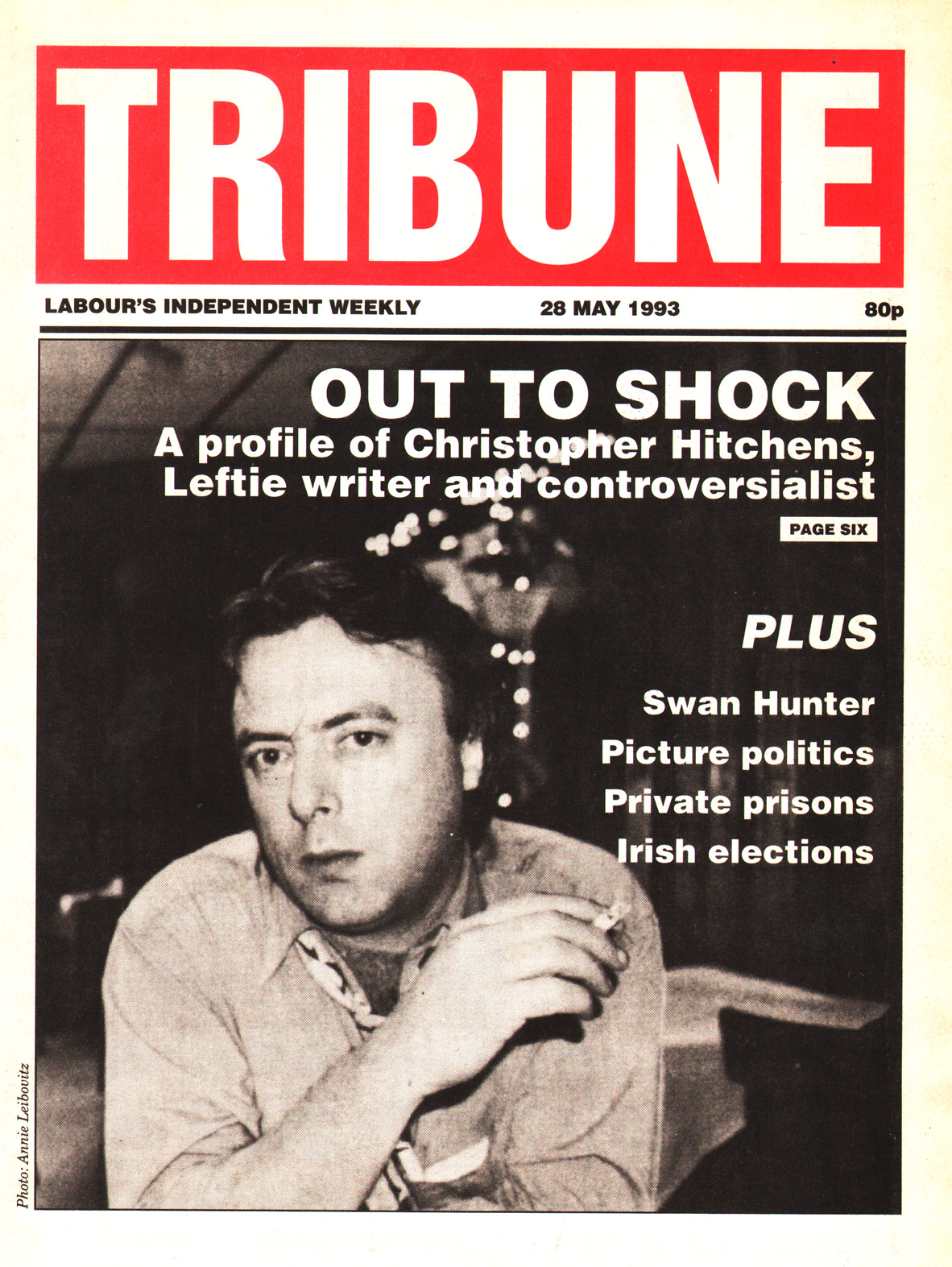
Tribune, 28 May 1993
The journalist and controversialist is back from the US to launch a new book of essays. He talks to Paul Anderson
“We play a game on the left in America,” says Christopher Hitchens. “Which election do you wish that the Republicans rather than the Democrats had actually won?
“Some very daring souls say that if Thomas Dewey had beaten Harry Tru¬man in 1948 there would have been no cold war,” he says. “People can never dare to take it back as far as Franklin Roosevelt. And some of them don’t agree with me that Barry Goldwater should have beaten Lyndon Johnson in 1964 – because then there would have been no Vietnam war.”
Hitchens, in London for the launch of his latest collection of essays, For the Sake of Argument (Verso, £18.95), delights in upsetting received wisdoms, particularly those of the left.
Indeed, he does it for a living. Since leaving Britain for the United States 15 years ago, he has written a column for The Nation, the American weekly that plays much the same role as the New Statesman here, in which he has made a speciality of stirring up as much controversy as he can in pursuit of hypocrisy and cant.
He has done much the same in many other Ameri¬can periodicals and, particularly of late, on television and radio talk shows, becoming something of a minor celebrity.
America, it seems, loves to hate Hitchens’s posh Brit drawl, his alien far-left politics and his ability to shock. Here, we get the articles between hard covers, and late. Some of the stuff in For the Sake of Argument dates back to 1987, although most, including the best of the columns from The Nation, are from 1990-92. Still, late is better than never.
The book includes pieces on an extraordinary range of themes – from P. G. Wodehouse through the delights of “Booze and fags” (written, he claims, “while cold sober”) to the fatwa against Salman Rushdie – and it is all worth reading. But the best bits, undoubtedly, are his commentaries on American politics, especially the no-holds-barred assault on Bill Clinton, which has been almost uninterrupted since the Arkansas governor started running for the Democratic presidential nomination.
“So what is all this garbage about ‘the new paradigm’ of Clinton’s forthright Southern petty-bourgeois thrusting innovative fearless blah blah blah?” he yelled at readers of The Nation in March last year after Clinton had authorised the execu¬tion of a prisoner on death row. “In a test of principle, where even the polls have shown that people do not demand the death penalty, he opted to maintain the foulest traditions and for the meanest purposes. As the pundits keep saying, he is a man to watch.”
It is clear that Hitchens is already well on the way to deciding that last year’s election was one of those that the Democrats should have lost. Clinton is proving precisely the disaster that he thought he would be.
“In the campaign, his only consistent point was to say that he would cut the tax burden insofar as it fell on the ‘middle classes’, whom he refused to define,” he says. “He wanted everyone who heard that message to think it meant them. Now he’s increasing taxes, mainly on the middle-income population, and everyone in the administration is pretending that this isn’t a breach of promise.
“You’re supposed to get points for lying in that way, and you do get them from the opinion poll racket and from the people who write columns in the bourgeois press. But actually it isn’t all that smart because people find you out quite quickly.”
Clinton, he goes on, was an establishment candidate, bankrolled by Wall Street and special-interest lobbies. “The reason substantial sections of the establishment swung to him is that they’re afraid of the underclass. It was the Los Angeles riots that got Clinton elected. His test will be whether he can bring in these people who are very nearly excluded from society.”
So far, the signs are ominous. The reform of the health service that Clinton promised during the campaign has already foundered, as has his at¬tempt to give a boost to the economy.
On foreign policy, “in many areas he’s worse than George Bush”, says Hitchens, quoting the new president’s policies on the Middle East (where Clinton has been much more sympathetic to the Israel lobby than his predecessor), Cuba (where he “campaigned against Bush from the right”) and nuclear testing.
“Whatever you think about Bosnia, it is only possible to say that Clinton has been contemptible. He played with all sorts of solutions, raised expectations and, when anything showed signs of giving the least political difficulty, he dropped it. By any standards, a really low-grade performance.”
The only thing that Clinton is good at, according to Hitchens, is appealing to the myriad of special-interest lobbies that make up so much of what thinks of itself as the American left: “He has manipulated images so that people in the gay movement, the feminist movement, the civil rights movement and the Hispanic lobby feel that privately he’s on their side.”
Hitchens is scathing about this pandering to what he calls “identity politics” – the idea that there is something radical about identifying oneself as a member of a group ‘“oppressed” by dint of sharing such traits as skin colour, gender or sexual preference.
His opposition is not based on a reactionary yearning for a society run by white male heterosexuals: rather, his point is that the growing importance of racial and sexual identities in politics is a symptom of social fragmentation, with no necessarily radical implications. “The left has falsely convinced itself that there are all of these individual emancipations going on, and I think it’s going to be disappointed. What’s missing in all this is any conception of citizenship or comradeship or the common good. And that’s too precious to give up to any special claim.”
Hitchens’s initial journalistic reputation was founded on his coverage of British politics in the seventies, particularly for the New Statesman. He left for the US and The Nation because “the Statesman was going down the karsy very suddenly and very depressingly and there was nowhere else that I wanted to go or would have had me. Everything else looked pretty lousy too: the experience of the Callaghan years, seeing Thatcherism coming. I thought: ‘If I don’t get out now, I never will.’“ Even the left of the late seventies suffered from “extreme crumminess”, and the Labour left was worst of all. “Internal fights on the National Executive Committee don’t make very interesting copy even if you’re interested in it,” he says.
For all this, he retains a keen partisan interest in Britain. He is, of course, no admirer of the contempo¬rary Labour Party. One of the best pieces in For the Sake of Argument is “Neil Kinnock: Defeat Without Honour”, written for The Nation after last year’s British general election, an excoriating assault on Labour’s failed strategy in the late eighties; “Tell us what you want, it wheedled the voters, and we will agree to stand for it. Here are our principles, and if you don’t like them, we’ll change them.”
Hitchens has not changed his mind in the past year. Unsurprisingly, he is particularly hard on the Clintonmania that hit Labour’s upper echelons six months ago. “Clinton’s victory was something to cling to after the humiliation of Kinnock: here’s the new paradigm – apolitical, technocratic, lowest common denominator – and it works!
“Labour has learned absolutely nothing from the defeat of Kinnock. All its leaders think is: ‘Well, we must try harder next time.’“ He remembers John Smith from the seventies as “a talkable-to guy”. But “throughout the whole of the Wilson-Callaghan humiliation I don’t think he gave the whips any trouble at all. He’s a conformist, a complete conformist.
“People always say: ‘Well, what about the alternative?’ That, of course, turns any dolt into a master political strategist, as we saw with the Kinnock team. ‘Consider the alternative’ would be my slogan.”
Tribune, 21 May 1993
Labour’s aid and development spokesman talks to Paul Anderson about Bosnia and the role of intervention
“Thousands upon thousands of innocent civilians to be murdered and mutilated and tortured,” says Michael Meacher. “Can the European Community really do nothing to stop aggression against a European country whose independence and sovereignty it recognised?” Needless to say, Meacher is talking about the war in Bosnia, a subject on which, despite being a member of the Shadow Cabinet, he has often come close to contradicting the cautious official Labour line expressed by Jack Cunningham, the Shadow Foreign Secretary.
Meacher, the MP for Oldham and Labour’s spokesman on aid and development, does not hold with the view that what is happening in Bosnia is simply a three-sided civil war in which no single side should be seen as the worst offender. Although “well aware that the Serbs have a case” and that “atrocities have occurred on all sides”, he clearly identifies the Serbs as the aggressors in the war.
Disgusted by the fact that United Nations humanitarian relief convoys have had to ask the Serbs’ permission in order to reach the besieged Muslims, he asks: “Can we allow UN authority to be made dependent on the will of the aggressor? If we live in a civilised world, we cannot allow these things to go on.” In line with this, he is much more hawkish than most of his Shadow Cabinet colleagues about military intervention. Rather than simply backing air strikes on the Bosnian Serbs’ supply lines if they continue to reject the Vance-Owen plan for cantonising Bosnia, Meacher wants deployment of ground troops to defend the Muslims against attack.
“It is hopeless to deliver humanitarian aid if we abandon people to be wiped out,” he says. “Safe havens must be implemented. That means giving real protection for the besieged Muslim enclaves and a new mandate for the UN troops there. There has to be UN defensive military protection. There is a difference between this and an offensive war, pushing the Serbs back from their ill-gotten gains.
No one is asking for that.” Meacher does not believe that intervention on the lines he suggests would take a massive army.
“A well-trained professional force, with modern technology, command of the air, helicopter gunships and armour could have a really big impact quickly.” While Cunningham has consistently portrayed the Vance-Owen plan as a viable basis for peace in Bosnia, Meacher describes it as “deeply flawed”. “It rewards aggression and ethnic cleansing. It depends on the creation of enclaves, undermines the unitary state and completely ignores the question of the refugees,” he says. “There are 2,500,000 refugees, most of them in the former Yugoslavia but some 500,000-750,000 outside. Are they to become the Palestinians of Europe? If so, even if we get a ceasefire, we won’t get peace but a running sore of violence in central Europe for decades to come.
“The only merit of Vance-Owen is that, if the Serbs sign up to it, it just might get a ceasefire. It is not remotely tenable as a long-term political solution: the difficulty is the map, which none of the three sides will accept, except perhaps the Croats.” The real issue, he goes on, is finding an alternative to Vance-Owen that could form the basis for a long-term political settlement. “I would still like to believe that there is a possibility of retaining a unitary state with a high degree of local autonomy,” he says. “The only other option is partition. We can’t rule that out if that’s the only way of keeping the peace. It’s certainly better than a whole series of wars.”
+++
Bosnia is not the only place where Meacher would like to see outside intervention in what traditionalists consider to be the “internal affairs” of a sovereign state.
Indeed, he considers that, with the tensions of the cold war at an end and hot wars raging in many parts of the world, the time has come for the international community to limit countries’ rights to carry on as they like within their own borders.
“There are certain extreme cases in which an individual country’s sovereignty should be over-ridden,” he says. “The first is genocide. The second is total breakdown of law and order and all government institutions, as we saw in Somalia. The third is when free and fair elections are held and deliberately over-ridden — Angola, Burma, Haiti, for example.”
Military intervention, he says, should always be the last resort: there is a whole series of other pressures, from withdrawing diplomatic relations, through withholding aid, to full-blown sanctions, that should be applied and found to fail before military action is considered. Equally importantly, all these pressures should be applied by the UN rather than by a single member-state or group of memberstates.
“This is nothing to do with neo-colonialism,” Meacher emphasises. “We’re talking about protecting innocent people from violence.” This notion of redefining the role of the international community in countries’ internal affairs is just one part of a “completely different foreign affairs and development agenda” that he would like to see adopted. With the cold war over, he argues, the great divide in world politics is between the rich developed North and the poor, underdeveloped, indebted South.
“I was staggered when I came to this job to find that current indebtedness of the Southern world is £850,000 million. The effect is utterly crippling. We are driving countries into impoverishment for decades to come.” Debt repayments by the poor countries to the rich ones are now almost double the total of aid from rich to poor countries.
“Debt relief is not only necessary but also in our own self-interest. It could create demand for our goods and services that we are not going to get from anywhere else. We must be crazy not to seize the opportunity to help ourselves and those in the South.” He suggests that 60 per cent of Third World debt be written off and easier terms agreed for the rest.
Meanwhile, he goes on, the rich countries must “reject the temptations of protectionism and remove barriers to the import of processed goods from the South”, in order ‘toles:Ince the Iatter’s reliance on primary products, prices of which have slumped in recent years. Structural adjustment programmes, the privatisation-and-deregulation packages forced on developing countries by the World Bank and the International Monetary Fund, “have repeatedly failed and should be denounced”, says Meacher. “We’ve got to come up with an alternative.”
On aid, he makes familiar Labour points about the Tory government’s halving of its commitment since 1979, arguing that the position has been made even worse by the diversion of large parts of the aid budget from the poor South to the countries of the former Soviet bloc. He also insists that “part of an aid and development policy must be protection of fundamental human rights”, with aid channeled only through non-governmental organisations in countries that are not up to scratch. Finally, he says that aid and development cannot be dissociated from the requirements of law and order.
“In Mogadishu last year I was shown a warehouse piled to the ceiling with sacks of maize. A couple of miles away, according to Save the Children, a couple of thousand people, mainly children, were dying each day. But the food could not be distributed because of the fighting.”
+++
Meacher’s enthusiasm is such that it is difficult to credit that he was given the post of aid and development spokesman last year as a way of shunting him to one side. Nevertheless, he clearly believes that his brief is not given enough priority by the contemporary Labour Party.
“Labour is not engaging with the electorate as effectively as it could be in evoking a crusade, a vision, a sense of purpose, in enthusing people,” he says. “There are people out there who need to be convinced that the Labour Party has got stuck in on the fundamentals. This issue could play a big part in it. The sufferings and viciousness of the civil wars across the world so totally over-ride the arcane mysteries of Maastricht that it is astonishing that the Foreign Office can be so wound up in something that is so navel-oriented.”